One of the things that always captures my imagination is the promise of future technology. For years, I’ve been following disparate things: smart glasses, artificial intelligence, the metaverse. And yet, the world today looks strikingly similar to the world of yesterday. I mean that literally - look around. What do you see?
So often, we hear these grandiose, wild, perhaps bland ideas about how the future will be completely unrecognisable to us. Think the Jetsons, or how everyone would live in a Holodeck one day, or something. We’d discard all our “useless” analogue constructs and move into cyber utopia with all these alien paradigms and a united Earth, or whatever. Nobody buys it.
When you looked around, you saw none of those things. We never cast a vote for an unrecognisable future. We are creatures of comfort, perhaps creatures of inertia, after all.
As someone who’s long been interested in computers and human interaction design, this is all very interesting to me. To predict the future, you don’t strictly require radical ideas. The future is shaped silently by the hand of small choices. We keep what makes us comfortable as the new things we adopt shape us in response.
Here, an example. Sometimes I walk around with one earbud in; access to artificial intelligence and able to communicate to anyone in my circles right there and then. Undeniably parallel to certain sci-fi devices that live in your ear. But really, it’s just a Bose wireless earbud that, through some chain of events, transitively came about because Apple didn’t want a headphone cable coming off their iPhone. A small “boring” decision that shaped my access to the world while doing the dishes.
I want to make a whole bunch of facetiously “boring” predictions like that. Or - maybe less predictions, more fantasy? I don’t know. I just want to paint an impressionistic work of what I want our future to be. Nothing that abandons the parts of the world we enjoy or have good use for. Just things I think can realistically come to pass and live inside of it, that would have an outsized effect on the human experience.
Expect this post to wander into various territories. It’s a stream of thought, if you will.
Compute that’s owned
I want to start with a linchpin idea; we own the devices which we do our personal computing on. Our data and digital lives are ours as they rightfully deserve to be. It’s not like the information cares where it lives, so there’s no reason it isn’t possible except for scarcity of compute, which I don’t think will come to pass.
When I say “data” here, I mean everything you consider yours: your photos, documents, everything. A personal cloud, for an audience of one household.
Perhaps it’s your phone, or some other device you keep on your person. That’s the easiest way out. But I actually aspire larger: one day, it’ll eventually be easy for someone to buy a “box” they put in their home somewhere, and it’ll “just work” as your personal hub, which your devices can connect to without much thought. No system administration. Wherever you are in the world, whatever happens to you, your box is always there. I think the physical separation and grounding in a stable location is important; a phone is too vulnerable to be that hub in my eyes.
I think it’s socially and politically important that it’s something you have full jurisdiction over. Many of the technologies we’re now building depend so heavily on privacy, to the extent that I don’t think we’ll be comfortable giving up all of our control to hosts who - by now - have pretty clearly been shown to have ulterior motives and broken trust. Local compute doesn’t need to be useful to capital.
If someone lands the product idea of “the box that just works” - if they really, truly make it “just work” beyond anything out there today - I see no reason why anyone would continue paying for a cloud subscription for these things. The problem is in the UX and the software, but I believe we have all the parts and it just takes someone to assemble them, someone to make the whole package, and enough people to buy into it to accumulate a critical mass.
Owned automated inference
I’m not much of a fan of hyperscaler cloud “automated inference” (yes - that’s AI to me) as a concept. I don’t think many people exactly are, these days. There’s so many problems with it, but I won’t belabour the point.
What I do believe in, is the idea of owned, local inference; the ability for local compute to be able to complete a reasoning trace, parse natural language requests, and perform actions as an agent on your hub with no data touching the outside world. I think we’ll get there: the memory crunch won’t last forever, and eventually - maybe even in the next few years - we will have boxes that are powerful enough to run inference models well-behaved enough to do anything a normal person would expect of it. The human-computer interface will durably gain its lowest-barrier and lowest-interaction mode yet: just asking.
I personally believe we’re not at the end of model optimisations. Our current models are bulky and inefficient - at some point, we will make something that’s smaller, more energy-efficient, and faster. Perhaps we get there through a more complete understanding of mechanistic interpretability. Maybe it just happens from new techniques to encourage gradient descent to take us to truer minima. But it must be possible in my mind. We can achieve gains in inference quality through better exploration of latent space. Scale does help with that, but it isn’t the only way to do it.
I don’t think it’s unrealistic to say that, on a single Mac Studio-sized box, you could run something as good as Claude Fable today, and for this box to be reasonably affordable and a common purchase for people who have some interest in having such a box.
User-space displays
What do I mean by user-space? In short: I think we’ll grow past the need for static, hard-to-move peripherals like monitors, and move towards display technology that can follow us around. We already started down this path with laptops and Bluetooth, and I think it’ll be completed - eventually - by wearable display technology. (I know, that sounds like LinkedIn boosterism, but let me justify it!)
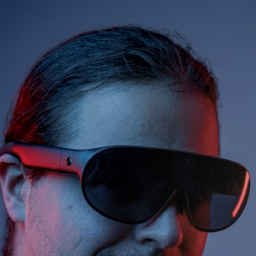
The same way that wireless headphones enabled us to listen more freely - walking around the house, doing chores, etc - I think there has to be a similar product development waiting for displays right now. We’re seeing glimmers of simpler products in the form of the Meta Ray-Ban Display glasses, but the tech is not quite ready yet, and I think it makes most people uncomfortable in use still.
But it’s getting close; even today, Meta have announced a pair of VR glasses that could - according to their specs - function as a monitor replacement without clarity issues. (For the nerds: they’re 37 ppd, which is clearer than even the Vision Pro!)
Depending on ergonomics - and that’s a huge if, because it’s about weight distribution, which glasses suck at - Meta’s VR glasses could be the first properly-viable monitor replacement device. Your content will be a bit bigger to keep text readable, and it won’t be anywhere near as sharp as, say, a 6K Retina display on your desk, but the real unlock is that you don’t need a dedicated computer setup anymore.
Pack a mechanical keyboard and an ergonomic mouse, and you have everything you need to recreate a great facsimile of a desktop experience. If that, because you can also use their hand-tracked virtual keyboard and trackpad to skip those things too, though I don’t think that’s right for everyone - physical tactile feedback still matters, so they’ll remain to serve that function. And - for sharing - perhaps we’ll keep tablets around, too. Displays that can be shared are just as important as displays for your eyes only. We are social creatures and it’s a mistake to forget that.
I think we’ll still do a lot of our work sitting at desks, of course. There’s no substitute for focus time. But I don’t think it’ll be locked to our desks, or our laps. We won’t have to do awkward dances balancing laptops in our hands when we walk around the place. Nor will we have to squint at small phones wishing we had a larger screen. We’ll just be able to access it everywhere; while we’re cooking, doing laundry, or running errands.
But - they’re still Meta glasses, and I know Meta doesn’t care for me personally. They care about money. Would they sell my apartment walls as advertising space, at my expense?
Longer term, my ideal device of this form factor would be something that you can own. I don’t particularly like Meta and I balk at the idea of handing over any personal information to them at all. They’ve handled privacy with disdain, as if it’s some kind of inconvenience. Perhaps Valve will do a liberated version of the idea in five years. I don’t know.
In any case, ideally the glasses would eventually just be like monitors: you swap out the glasses, you keep the puck that does the compute. And everything loops back into your box, of course. That’d get rid of all these vendor problems; changing your glasses would be as easy as changing your mouse. But for now, we’ll run with the glasses as a near-future “MVP” of sorts.
Whisper voice input
One further development I’d be excited for are voice interfaces that preserve the privacy and confidentiality of the user using them. Voice is undeniably efficient for certain tasks; I send my friends tons of voice notes, and have gotten into voice-noting my local AI box too as a way to lubricate the process of getting ideas out in the way I’m thinking about them. If I could do this anywhere, without other people hearing every word, it might be one of the main ways I interact with a computer in situations where carefully composing sentences isn’t a requirement.
I think the direction this is going to go is towards what I call “whispering” - low- or no-volume diction of words, either through earbuds, or maybe through some kind of contact microphone. I remember seeing an MIT prototype of such a thing (AlterEgo), and products like the Meta Neural Wristband show that we’re able to respond to how a user intends to move their body.
(I will say, following the wristband example, it’d be incredibly entertaining and hilarious if everyone started collaring up like dogs. I know a few people who’d love that. We won’t discuss further.)
Between the display tech, whisper tech, and “neural” stuff, I do think there’s a through-line of privacy here. Societally, we’re at a bit of a crossroads right now: it’s become possible to monitor everything, and we’re now faced with real tradeoffs to make. There are clear advantages to cameras and microphones everywhere, and even more clear disadvantages. How do you trust the person with the cameras and microphones on is going to respect your data?
We can’t rely on people finding cameras and microphones or knowing whether they’re recording or not - this gets into “discovering spy tech” territory, and that will forever be a rat race. Technology will not save you from technology.
There has to be a new social contract here that reaffirms the right to remain private and off-the-record, and someone who writes software for a job is honestly the last person you should be talking to about that. Ask one of my siblings who got a Master’s in Philosophy instead, perhaps.
The only thing I can tell you is that we’re firmly on the wrong side of privacy right now, and it’s being taken advantage of by tech companies who aren’t thinking about the implications of continually processing and uploading data gathered from all of these sensors, much of which doesn’t record the sole “consenting” user of the device.
A smaller internet
This is probably the most cynical of the predictions here. I think we’re going to retreat from most truly global communication, reserving it for fewer things, because we’re in the process of discovering that connecting people worldwide isn’t actually a universal good, and that access is exploited both by those who mean well and those who mean ill. And to that end, we’re going to develop different technological standards that shape themselves to that social reality.
I don’t mean to imply the internet is going to die or anything. I mean - look - I’m a Gen Z person, and I’m writing to you here. But the internet has forever and irrevocably changed since the 2000s. We’re not blind to the consequences of presenting yourself to an audience of millions: it’s essentially a kind of forever-memory that can never be undone, and invites some of the unhealthiest interactions we know by virtue of being able to reach the people who are capable of causing those problems.
These things used to be limited by the borders of your village or neighbourhood. Things didn’t follow you everywhere. Plus, people forgot and forgave. Every action you did had a half-life.
That’s not true anymore, is it? Context collapse.
As much as I admire projects like Bluesky for their optimism about global connection, I actually think the real answer is in dedicated community-building. Research already starts to point in the direction of managing “friend groups” as an actual construct in social networks, and this absolutely lines up with my own lived experience of being in my generation.
This all comes down to an issue of trust. If I had to predict the shape of the system, I’d characterise it in four layers that every social location can fit into:
- The fully-public: general purpose “for everyone”, near-zero trust, tons of spam, bad behaviour, and few consequences. Think of the junk that gets sent to your email, SMS, or thrown around on Twitter. The only value here is in outreach; nobody really stays here for long.
- The semi-public: low-friction open-door communities you choose to be a part of, moderated by people whose terms you agree to. A safer and more pleasant space to be, but still visible to others, so trust is still low. Think of a subreddit.
- The semi-private: closed-door communities you’re invited to and not visible to the outside world. Consequences are greater, leading to a higher-trust and more stable environment. Most people will prefer to spend most of their time here. This is where closed Discord servers live.
- The fully-private: conversations you seek out directly with others, or with small groups of people you choose. The weight of human relationships fully governs behaviour here, and so is the most stable and safe. This is where Signal lives.
Bluesky has successfully developed a suite of tech that fits in the top two categories, and which gives people that ownership over their data that I consider to be so essential. For that, I’m pretty thankful.
But that’s not where the real work is; the real work is in developing alternatives for those more private options. This is hard to do in a way that gives users agency: the internet is designed to be aggressively open, so the only real way to do this is to form kinds of access-controlled “sub-networks” embedded in the internet.
There’s a few projects in this space; for example, Bluesky is working on “ATProto Spaces”, a new technical standard for how to create small sub-social-networks that don’t go through the same public infrastructure and have stronger access controls. So that’s good, but I’m interested to see what other standards develop in the space.
Where this is all going
You might wonder why I’ve kept making diversions to social issues in a post that’s otherwise about technology, and that’s because this isn’t really a post about technology, is it?
It’s about the human experience.
The way we socialise and interact with each other is a huge part of the experience of being alive - beyond all this tech we’ve surrounded ourselves with. We built this tech for us, and ultimately what it becomes will be a reflection of us.
A large part of the reason we’re scared about what technology can do now, and why we keep getting the “bad versions” with all the privacy problems and negative social outcomes, is because our incentives have been fundamentally misaligned.
With the commodification of so much of what humans do, there’s one big change coming right for us all - and that change is in how we nurture the human contribution. We’re not in a post-scarcity utopia yet, but I predict we’re not far from the inflection point where some people are - strictly economically speaking - useless to capital. We already have people undervalued like this in our society, and they’re not cared for properly: mothers, teachers, and the charitable. Even if we pay them, it’s not in accordance to how important they are to people, is it?
We should not make technology that is useful to capital. We should make technology that is useful to people. Human experience first.
We’re allowed to get excited about new hardware, and the ever-expanding frontiers of what computers can do. Never feel guilt or shame for looking at what computers can do. But it’s equally important we consider what computers should do, and how it impacts the people who use them. That doesn’t mean “abandon the joy”. It just means we should think about things as people living in a wider world, and not be blind to the consequences of our actions.
So, that’s the biggest suggestion in this post: how will we - the humans - change the world so that technology does not obsolete the human experience? And hey, maybe it will make us all look like dorks with single earbuds in and big glasses on? ;)